Welcome,
Paradox Foundry started out just like anything else…
A seed.
A seed of curiosity.
If one were to create something, what would it be?
What “could” it be?
If you think about it–
With a phone and free software- what could one actually build?
I have always been a writer. I've written many things across the years; most edging on Philosophy and/or Spirituality– and with that gift there has always been a gnawing fascination with what technology could become and how far it could go as well.
I will address that here.
AI.
Artificial Intelligence.
The use of AI in Paradox Foundry is predominantly a visual production tool. I say predominantly because the Universe, philosophical framework, the Orders and creative direction originate solely from a human mind with an Undergrad study of Philosophy as a formal academic practice and the extensive personal Spiritual exploration of human consciousness; though I will allow some drafting to be done for soft canon design for the sake of generating a complex Universe at scale, for now.
This will be phased out incrementally as I would prefer the project to read as it would be spoken and not hollowly fabricated.
~~~
The Paradox Philosophy is meant to encapsulate two ideals, primarily:
1.) Formal fields of Philosophy, cut and dry.
2.) The human experience within an analytical mind.
“The unexamined life is not worth living.”
~ Socrates
Greek Philosopher, 470/469BCE - 399BCE
The fields of study utilized as the scaffolding for Paradox Foundry can be found and lightly touched on in the FAQ’s (Start Here) page of this website, ParadoxFoundry.Net, near the bottom, highlighted in yellow.
The human experience is something much richer and can only be explored through the subjective lens of a person.
The Seven Orders do orbit the principles of Philosophy for the sake of In-Universe Worldbuilding; but they are also meant to envelope so much more of the human experience.
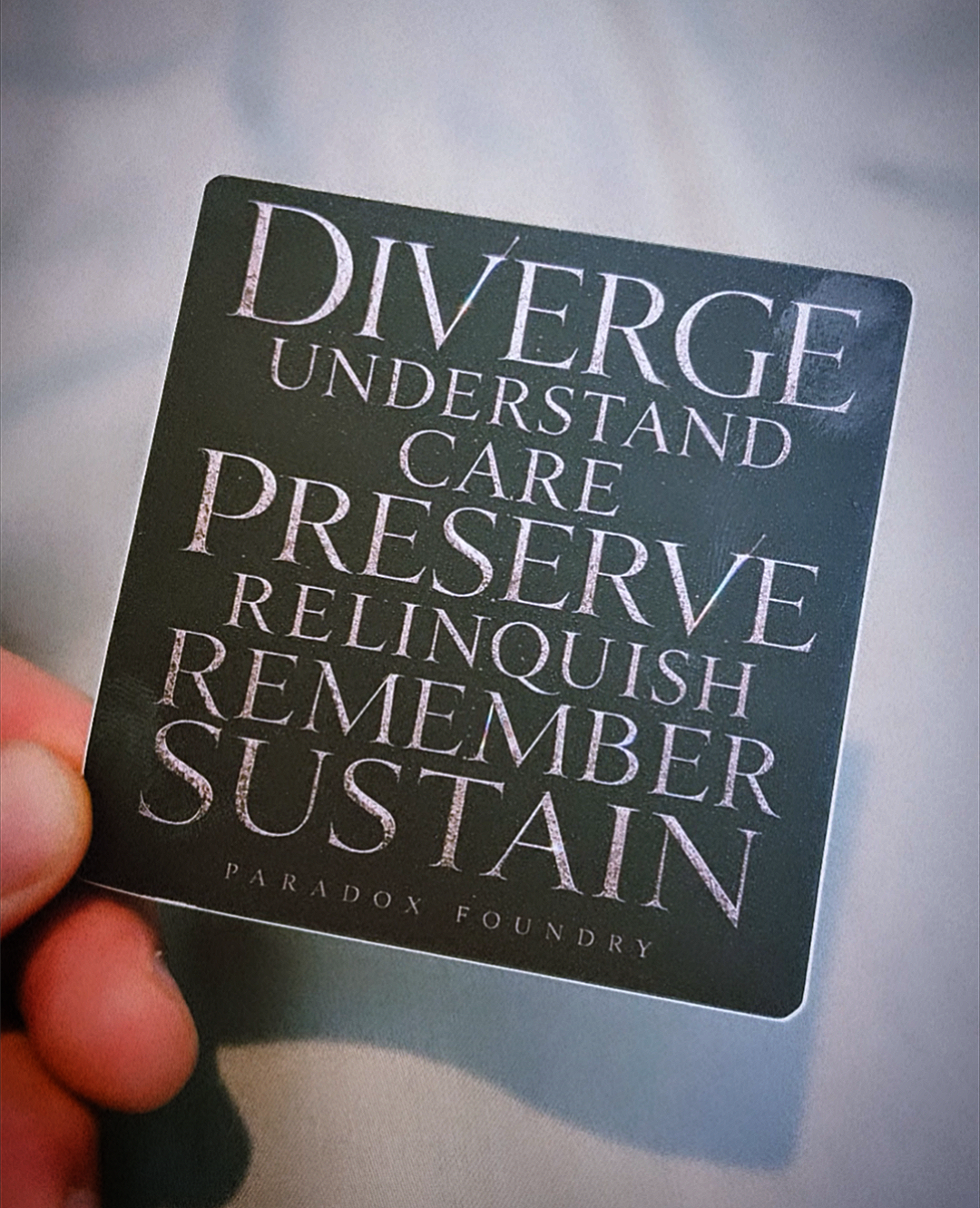
The Unbound : to Diverge
We all begin here. We didn't ask for this world or our existence or the cards we were dealt and many of us are swiftly met by a world that is indifferent to our wants and needs. Adaptation becomes a necessity both on a micro and macro scale for our own survival if we wish it to be effective. To Diverge is a very primordial and existential human compulsion that can become either intrusive or obsessive, or both, if permitted. We ask intuitively - what can I do? What can I be? Where can I go? What are my boundaries? What are the consequences? What's worth my time and energy? What do I want vs. what do I NEED to survive? These instinctual questions brood their way through our cortex through our entire lives as we face the world day in and day out seeking to establish our own Identity. Too little searching results in a weak identity; too much may lend itself to overcompensation and a loss of true identity– but the human experience does not stop here, no- this is only the beginning of our own personal tension deep down inside each one of us. The human mind then seeks to know more…
Noetic // Tide : to Understand
We as humans are thrust into a world with an overwhelming amount of data that we must then contend with- to discern what is pertinent and what is not and early in life for many of us, even through the struggles of establishing our own shaky footing of identity, do we also have to confront our own limitations with what we can truly know and then align ourselves with a system that adheres to daily functionality in accordance with the information that we've accrued. Do we know the sun will rise tomorrow just because we've seen it do so thousands of times or do we simply believe that it will? Do you truly know that your car will start in the morning before work or do you simply have faith that it will because you've grown accustomed to an understanding of mechanical predictability? There are many questions that our minds learn to sort into subconscious categories betwixt knowing and believing. Can they be one in the same?
And what about others? As we are clearly not the only ones inhabiting this rock; ruling out the Brain in a Vat Theory or anything solipsistic of the sorts…
Mercy's Burden : to Care
Excluding all extreme narcissistic personality disorders, the majority of humans find themselves longing for community. It's baked into us– interwoven, firm pressed, stitched and inoculated through our very helixical fabric. Humans find themselves wrestling with morality almost as early as we are clutching for our own sense of identity or comprehension of the world as we quickly understand that we are not the only avatars to occupy this space. We learn boundaries. We learn give and take. We learn reciprocity, gratitude, camaraderie, brotherhood, sisterhood, what family truly means - blood or otherwise. We establish friendships, alliances, we are betrayed and we hurt others just the same. We feel guilt, shame, disgust, we reflect, we introspect and we grow. This is how we develop and find our place in the world. We sharpen ourselves amongst others. Humans are, for the most part, a communal and tribal species. We exist for our own experiences but those experiences are so deeply saturated and embroidered by the moments that we experience with the other souls we come to know. Our burden then becomes morality; the constant struggle to define our own boundaries and to decide where our own line is between being selfish– and selfless.
The Measure Eternal : to Preserve
As we mature, some of us begin to feel more comfortable with who we are. We begin to understand the world around us and we begin to decide who around us we want to align our time and energies with. We then begin to have more complex thoughts surrounding investment. What is actually mine? What do I want to keep? What's actually worth having? Do I hoard everything? Do I keep things purely out of utility or do I allow pieces to stay if their only function is sentimental value? What's actually worth preserving? What has value to me? This is very Measure Eternal. As surely as we establish who we are and who's company we're ok bartering our time with, we also begin keeping a mental inventory of our possessions as we assign arbitrary meaning to the objects we accrue. We decide, is this junk- or treasure? Shall I keep this? How important is this thing to me- really?
And just like that, we discover a threshold.
Pilgrims of Zero : to Relinquish
The next most reasonable stage of discernment. As we grow, we change. It happens a bit by our own decisions- but mostly against our will. A mature understanding will begin to teach us that not everything needs to be kept- and more unpleasantly, not everything ‘can’ be kept. We begin to learn how to let things go. Much like one of the core tenants of Buddhism, some humans develop an understanding that suffering is attachment. That is to say that at a point, we no longer own our items but rather our items begin to own us. Some people become lost in the addiction of keeping for various reasons whereas others discover the mental liberation of letting things go; whether they be physical or mental clutter. To be a pilgrim on a spiritual path to zero is to establish a very visceral relationship with release and relinquishment; to liberate one's Self from the inventory they've accumulated through decades of existence. Understandably, there are some things that keep a tighter grasp on us than others– and we also learn the stark difference between letting things go voluntarily and having things taken from us against our will.
Comically, a quote from one of the most famous video games of all time, The Legend of Zelda Ocarina of Time conveys it well~
"The flow of time is always cruel. Its speed seems different for each person, but no one can change it.
A thing that does not change with time is a memory of younger days..."
~ Sheik
Enter the Choirs–
The Choirs of Epitaph : to Remember
Deep reverence begins to take root between the places in our minds where we've planted and tended to our most precious memories. The older adult mind will begin to contemplate more frequently with the impending reality of mortality. It's a door we all must walk through. No one asked us if we wanted to enter in the first place- yet we are here. We did our best, we played our part, we investigated as much as we could and now we're forced to reckon with the daunting reality of walking back out and leaving it all behind. We don't know what's beyond the door but the room has been getting smaller since we arrived and it's the only way out.
*heavy sigh*
None of us are getting out of this alive; not in the same condition we inhabit right now. No one ever has. However, none of us truly know what awaits us on the other side, either. Theists and Atheists (even the agnostics) may gather here now for routine ritual combat… but the reality is, none of us know what exists outside of our own skin containers. As we ourselves climb the rungs of an aging ladder, we find ourselves at the funerary services of others and we remember who they were. We remember many things. We collect more memories than objects anymore and some of us take our ponderance even further—
Ontic Rune[s] : to Sustain
Philosophy as an academic practice can be the exploration of discourse and analytical hair-splitting across an infinite gradient of domains; but it can also be a very personal way of thinking, understanding, identifying, caring and processing. It becomes a compass. A personal philosophy at a point takes the hand of Spirituality and becomes the modus for each of us to navigate between our beginning and end point. All of us will be thrust through the gambit of human emotions and experiences. We will establish our own understanding of good and evil and everything between. We'll acquaint ourselves with our nation's politics, global politics, the humanities, moral impositions, our own personal obligations and where we fit within each of our respective narratives as we all confront our own sickness and decay. To develop the Ontic shift in conceptualizing is to wonder… Why is any of this here at all? Where did it come from? There has to be a beginning, right? But when? How? How could something not have a beginning- yet simultaneously there must have been something before that, right? Surely? We seek coherence because our brains seek to categorize and understand a Universe that seems to exist dichotomously.
· That is the Paradox ·
We know absolutely nothing. We have beliefs and we argue about what we can know. Even in our most eldest moments we are barely children to the infinite cosmos. We agree and disagree on how to treat each other constantly based purely on unwritten rules or written but loosely verifiable doctrine. We accrue some things, we take them with us and eventually we decide that some things don't have to come with us anymore. We think about the people we shared space with and we remember the ones who've left the room and we wonder where they've gone and if they're better for it. We realize that we must follow with our own undetermined time and location- but while all of that is happening some of us still wonder–
Why?
How?
Traditionally, a foundry is defined as a factory that melts and pours metal into molds to create parts and castings. Is that not what we're doing, relatively speaking? Are we not being forged by the effects of existence and poured into little skin suits to serve a purpose, like a tool to necessitate a function before we wear and degrade and are broken down once more to sustain the next batch of materials for new life to establish its shaky legs and materialize its own sense of identity?
Consider this:
Each of the Orders represents a core branch of Philosophy.
Each of the Orders also represents a core chapter of the human condition.
None of this [Paradox Foundry] was configured by accident.
The realities that we face each day are the conditions of a cosmological forge.
I view each of you as a fellow Archivist, members of a corporeal repository where we catalog and record our memories, our experiences, our lives and our questions together. In Philosophy, we ask a great deal of questions and our answers are usually up for debate. In the Universe of Paradox Foundry it is no less convoluted. Nonetheless, I would like to thank each one of you for exploring this world with me as we do our best to navigate and understand it.
On behalf of Lyra & Myself,
Welcome to the Archive