EPISTEMOLOGY & GNOSIS
“What can be known and how can we know it?”
Shadow: Relativism / Skepticism
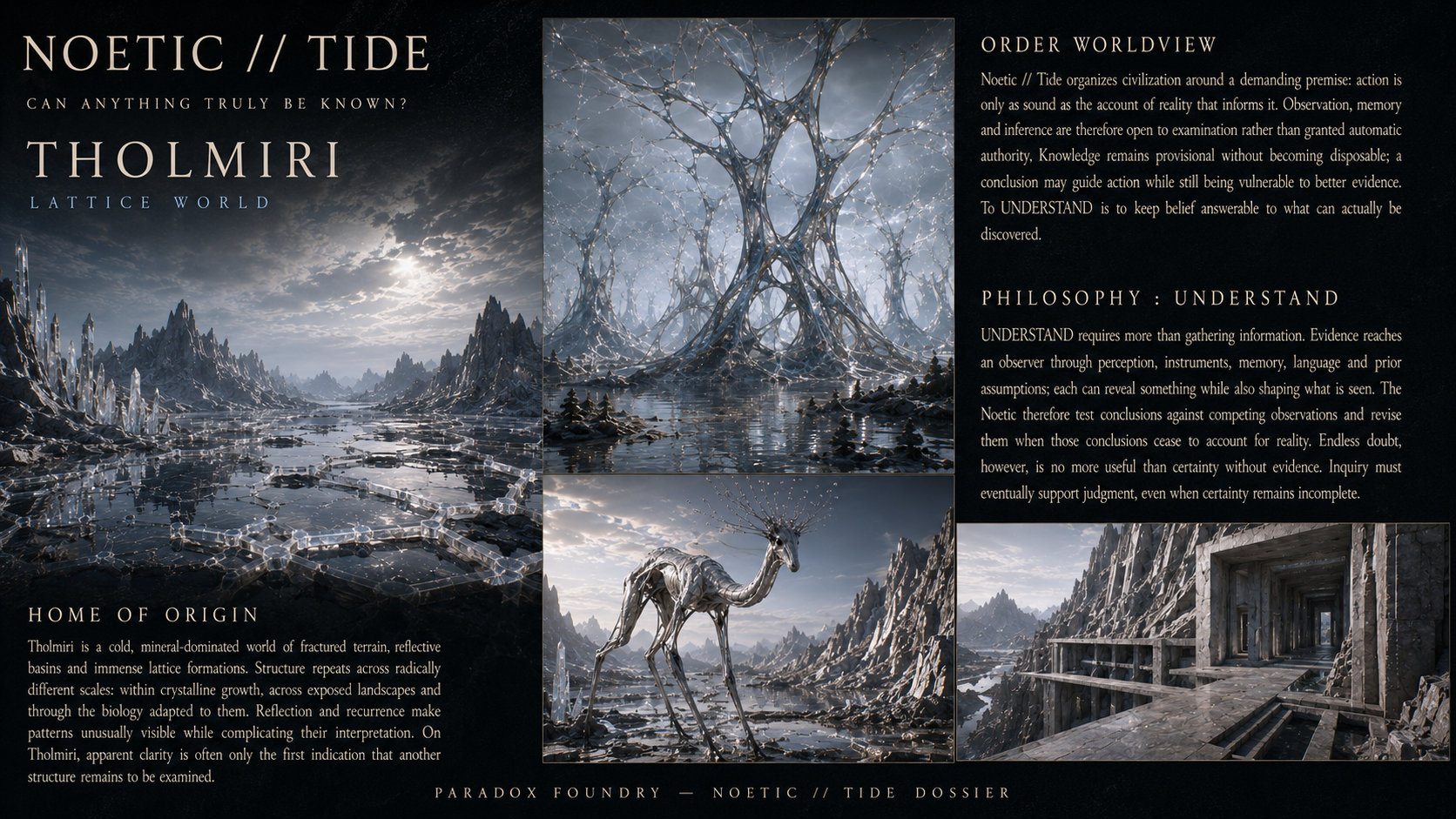
Foundational Belief: Noetic // Tide believe that understanding is civilization’s highest pursuit. Through the study of consciousness, memory, perception and truth, they seek ever deeper knowledge- convinced that reality can only be navigated through understanding.
Adolescence and early adulthood. Once possibility explodes, self-reflection begins. Who am I really? What do I believe? Can I trust my own perceptions? What is truth? This is the beginning of philosophy. What can be known? Can consciousness know itself? What are the limits of knowledge?
For Noetic // Tide, UNDERSTAND is not synonymous with possessing information or producing correct predictions. Information may describe reality without explaining it and a prediction may succeed through correlation, flawed reasoning or luck. Correctness alone therefore does not constitute either knowledge or understanding.
Knowledge requires a belief to correspond to objective reality and to be held for epistemically legitimate rather than accidental reasons. Understanding goes further: it requires grasping the actual relationships, mechanisms, or causes that make the known truth what it is.
Understanding is also relative to what is being claimed as understood. A Noetic may genuinely know and understand several constituent phenomena independently while remaining ignorant of the larger system connecting them. Understanding the parts does not entail understanding the whole until the relationships among those parts are themselves recognized and correctly understood. Thus, for the Noetic: To know is to possess truth non-accidentally. To understand is to grasp why that truth is true and how it relates to the thing being understood.